• Skip to primary navigation
  • Skip to main content
  • Skip to primary sidebar

ArtSpirit7

  • Home
  • Events
  • About

14 Tips from Wayne Freedman on Storytelling

June 11, 2012 by Mary Gow

The keynote speaker has won 51 Emmy Awards from the Northern California Chapter of the National Academy of Television Arts and Sciences. That was plenty of endorsement for me to see Wayne Freedman as he led the first half of a workshop I attended where six San Francisco television journalists shared their tips on telling news stories.

The official event title of the day-long was the “National Academy of Television and Academy Sciences (“NATAS”) Storytelling Workshop.” It was put together by video journalist and photographer Jeremy Carroll and held at the American Broadcasting Company-owned station, KGO-TV, in San Francisco.

The list of presenters included four video journalists:
-Wayne Freedman of KGO-TV
-Jeremy Carroll, photographer for NBC11
-Da Lin of KRON-TV
-Garvin Thomas of NBC Bay Area Proud

and television reporters:
-Julie Watts of KPIX (CBS)
-Noelle Walker of KTVU

Freedman’s book, It Takes More Than Good Looks To Succeed at Television News Reporting, is now in it’s second edition (2011), and required in many college journalism programs in the U.S., Canada and Europe. He shared some information on storytelling that’s worthy of sharing:

1) Feature writing techniques may work better for many television news stories than the traditional news story structure. Instead of putting the most important relevant facts first and the details later, tell the story with a beginning, middle, and end. And add an element of surprise or a big reveal.

Freedman gave several examples of how storytelling is strengthened by not going in chronological order of the actual event and moving elements around. For example, a story he did about a woman’s freeze-dried dog. The order of reveal is not chronological.

2) Storytelling is about structure and timelines. There’s not one timeline, there’s three:

a) the order of events;
b) the order which you shot those events; and
c) the order you put the timelines in the story.

Move the timelines around to add more interest, which changes the structure.

3) Set the Scene. This might be done with one line or ten lines. Don’t give away the story with the first line or begin with the punch line.

4) The viewer needs to have an emotional investment in the subject. Television is a visceral medium. “The road to the head goes through the gut,” said Freedman. Tell stories through people. Compelling stories are visceral stories. “Visceral” means appealing to our instincts more than our intellect.

If the viewer cares about the person they’ll care about the story. Find a person to tell a story. “Sometimes you can tell two or three stories through one person.”

Read more about this Wayne Freedman’s tips in my next post.

You might also like:
–7 Elements to Include in Digital Storytelling
–4 Simple Tools for Effective Storytelling
–Where Do Opals Come From?


Filed Under: Books, Writing Tagged With: books

Big Red Breathing Lotus Flower

June 4, 2012 by Mary Gow

Coming out of the garage heading to San Francisco City Hall I couldn’t miss this beautiful lively inflated red lotus flower sculpture. The leaves are motorized though the wind helped them move even more. “Breathing Flower” was created by internationally renowned Korean artist, Choi Jeong Hwa. The flower opens and closes as though it’s alive!

This piece was installed on May 16, 2012 at a spot formally known as Civic Center Plaza, across the street from the Asian Art Museum and the San Francisco Public Library (which currently has some intriguing huge photographs pasted on the front and side of the building, reminding me of JR, the 2011 Prize Winner of the TED Award).

The large photos range from five to fifteen feet tall and are the first artworks ever to appear on the exterior walls of the San Francisco Public Library. The “Making Mothers Visible” show is part of a global photography exhibition sponsored by the International Museum of Women.

Getting back to the video above. There was someone handing out flyers and music was coming from their boombox. It magically matched the poetry of the moving flower.

Thank you Choi Jeong Hwa for your creative inspiration!

You might also like:
–Inspiring Rotating Amusement Devices
–Introducing the Lumbrella!
–Ten Design Principles Worth Remembering

Filed Under: Art, Images, Inspiration

3 Things to Like About “Gerhard Richter Painting”

May 28, 2012 by Mary Gow

I thought the Gerhard Richter Painting movie would only be here a week but it arrived in early May and it’s still running in San Francisco and Berkeley. In case you haven’t heard of Gerhard Richter, he’s an internationally accomplished, energetic 79 year old artist from Dresden, Germany, with an extensive body of work that covers over five decades. I didn’t discover him until a few years ago.

You may find out all you need to know about him at his website. It’s one of the most thorough artist sites I’ve seen, created and maintained by Joe Hage.

Richter currently has a studio in Cologne, Germany. A superbly detailed chronologyof his life is on his website.

How famous is he? One clue is his painting, “Abstrakis Bild,” sold for $20,802,500 at Sotheby’s in 1997!

It is not a reflection on the movie but I was true to a habit of mine and fell asleep briefly during the film. I am not sure what I missed, but I enjoyed the gentle pace and the peek inside Richter’s life.

Implanted somewhere past the beginning, there’s a montage of photographs from his childhood, and how his family had to move to Poland. He talks briefly about how his parents wanted him to be a doctor, then he tried becoming a dental assistant and failed at that.

You get to see how much his studio assistants help with mixing paints and photographing his art, and an array of other tasks. His wife, his manager, and various museum and gallery personnel make an appearance as well. Once in a while you hear the filmmaker, Connie Belz, asking him questions while she’s behind the camera.

The movie documents Richter between April and September of 2009, at work in his studio in preparation for a show at the Marian Goodman Gallery in New York. But that’s not all you see about how he prepares.

One of my favorite things was seeing the meticulous preparation made for exhibitions. There’s careful study of the space using to-scale architectural models dissecting every wall, hallway, and sometimes the lighting system. Then shrunk to-scale Richter paintings are placed on the model’s walls to see how it will look.

Later in the movie there’s what I think is a big reveal — the work hasn’t always been created yet even though the show is already booked!

Abstract 525 by Mary Gow

“Abstract 525,” Mary Gow’s Gerhard Richter-inspired painting

The second favorite thing I liked was seeing this world famous artist like his work and two hours later hate it, and two days later like it again. Richter admits sometimes he doesn’t know where the painting is going, or it doesn’t go where he thought it would as the painting has a life of its own that he honors.

One other thing I really liked was getting to see the use of Richter’s custom-built giant squeegee. He paints an undercoat of colors which in themselves look like a finished abstract painting. In the example towards the end of the film he says he uses red in the undercoat because he’s going to squeegee green. Then he applies one big glob of paint on the canvas and moves it either across or down with his arms wide (maybe 5 feet) squeegee. This looks like palette knife painting taken to a scientific level! How gestural can you get with a palette knife that size?

I don’t want to ruin the surprise at the end. There you’ll hear the three words that say what making art is all about to Richter.

You might also enjoy:
–5 Reasons to Get Thee to the Getty
–10 Memorable Quotes from the Founder of Zero Point Painting
–5 Resources for Selling Your Art Online

Filed Under: Creativity, Images, Inspiration Tagged With: art, Gerhard Richter

12 Ways to Embrace the Galactic Alignment of 2012

May 22, 2012 by Mary Gow

Rose during Solar Eclipse

Rose at the Eclipse, photo by Mary Gow


Are you feeling a creative surge of energy from the solar eclipse on May 20th?

“[D]uring periods of great change, personal creativity is radically enhanced.” – Barbara Hand Clow

I am feeling that surge of energy that San Francisco astrologer, Linea Van Horn, calls the Galactic Embrace. According to Van Horn, 2012 marks the peak of a span of time we have been approaching for the last 30 years, 6,000 years, and 26,000 years.

Safely watching the solar eclipse of 2012

Safely watching the Solar Eclipse of 2012

In Van Horn’s “Galactic Embrace” presentation to the San Francisco Astrological Society, she used two hula hoops to explain what is going on in our galaxy. Imagine one hula hoop spinning east-west, the other spinning north-south. One of the hula hoop includes our solar system. The other spinning hoop and represents the Milky Way. The “precession”) of equinoxes in our solar system brings about a super-unique (my term) proximity to the Milky Way.

We are at the special spot where these two hula hoops touch. Van Horn explains that it takes 26,000 years for the zodiac to circle once around the constellations.

John Major Jenkins’ diagrams about the galactic alignment help explain the “precession of equinoxes,” if you want to check those out.

“We are now in a temporary portal of time and space that invites us to participate in no less than the evolution of mankind and the earth itself,” says Jenkins, author and independent researcher who focuses on Mayan culture and civilization and its connection to the cosmos.

Not only was there an annual solar eclipse on May 20th, but there will be a lunar eclipse on June 4th followed by what is called an “occultation” (a fancy name for eclipse but rarer) of the planet Venus traveling between the earth and Sun on June 5th and 6th. This is a completion of an 8 year cycle that only occurs every 121 years!

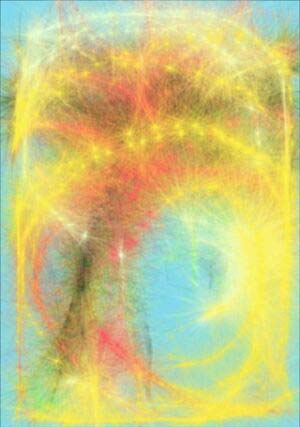
Ecliptical, drawn using Harmonious app

"Ecliptical," drawn with Harmonious app, by Mary Gow

2012 represents the culmination of a zing of energy that has been building and building. Van Horn offers some tips for embracing this special time:

1. Congratulate yourself for being alive at this remarkable time.
2. Do what matters to you.
3. Be grateful!
4. Simplify.
5. Help others.
6. Plant good seeds.
7. Be flexible, ready to change at a moment’s notice.
8. Let the past go, don’t hang on.
9. Hold steady in your light.
10. Limit your exposure to “news.”
11. Resist fear.
12. Cultivate good will and positive thinking.

Van Horn has been an astrologer for over 35 years and will be presenting at the annual conference of the United Astrology Congress in New Orleans this coming weekend and at the the 44th Annual Conference of the Astrological Association of Great Britain September 7 to 9 at Wyboston Lakes.

Looks like there is no better time than the present time to be creatively expressing. If you’ve been waiting for when the planets are aligned, the time has arrived!

You might also enjoy:
–4 Quotes to Jumpstart Your Dreams
–Two More Nuggets of Inspiration from Ira Glass

Filed Under: Creativity, Images, Inspiration

  • « Go to Previous Page
  • Page 1
  • Interim pages omitted …
  • Page 50
  • Page 51
  • Page 52
  • Page 53
  • Page 54
  • Interim pages omitted …
  • Page 97
  • Go to Next Page »

Primary Sidebar

Welcome to ArtSpirit7!

Here you'll find news, views and inspiration as Mary Gow shares some of her discoveries as a mutli-disciplinary artist and overall curious person.

Recent Posts

  • A Celebration of Book Arts
  • Louisa Crowley’s Ceramic Sculpture Brightens the Everyday
  • ABSTRACT ON FABRIC
  • Mary Ciofalo at Sanchez Art Center
  • Observations
  • A Real Life Urban Hero

Favorite Posts

  • Joy-Lily Transforms Fabric Into Art
  • What’s in Your Bag of Tools?
  • Tips for Getting Unstuck
  • The Many Expressions of Amaroq de Quebrazas’ Magical Realism
  • The Insecure Way is the Secure Way
  • Gow-O-Gram No. 2
  • Messages from a Spirit Photographer
  • 5 Resources for Selling Your Art Online
  • Three Things to Like About Gerhard Richter Painting
  • What Does Your Favorite Shape Say About You?
  • Awaken to Your Dream
  • Is This the Year You Do the Work?

Categories

Click Any Tag

abstract art Abstract Painting Aeolian Harp Angels art attentionometer Bill Belew blogging books Calligraphy creative inspiration creativity David Delp Gerhard Richter Gow-o-gram graphic facilitation heart heart art hearts Hero's Journey Inspiration Ira Glass Joseph Campbell Julia Cameron Mary Gow Mary Gow art Mary Pecci Mel Ash monotypes Pachamama Alliance Painting Paper Artist Paul Gallo photography public speaking Seth Godin shapes social change Steve Jobs Steven Pressfield storytelling The Artist's Way Tyler Mitchell watercolor yourturnchallenge

Archives

  • October 2025
  • August 2025
  • July 2024
  • June 2023
  • May 2023
  • April 2022
  • December 2021
  • November 2021
  • October 2021
  • July 2021
  • May 2021
  • January 2021
  • December 2020
  • November 2020
  • September 2020
  • July 2020
  • April 2020
  • March 2020
  • February 2020
  • January 2020
  • May 2019
  • April 2019
  • January 2019
  • November 2018
  • July 2018
  • May 2018
  • April 2018
  • January 2018
  • December 2017
  • November 2017
  • October 2017
  • September 2017
  • August 2017
  • April 2017
  • March 2017
  • January 2017
  • December 2016
  • November 2016
  • August 2016
  • July 2016
  • June 2016
  • May 2016
  • March 2016
  • January 2016
  • December 2015
  • November 2015
  • October 2015
  • September 2015
  • August 2015
  • July 2015
  • June 2015
  • May 2015
  • April 2015
  • March 2015
  • February 2015
  • January 2015
  • December 2014
  • November 2014
  • October 2014
  • August 2014
  • July 2014
  • June 2014
  • May 2014
  • April 2014
  • March 2014
  • February 2014
  • January 2014
  • December 2013
  • November 2013
  • October 2013
  • August 2013
  • July 2013
  • May 2013
  • April 2013
  • March 2013
  • February 2013
  • January 2013
  • December 2012
  • November 2012
  • October 2012
  • September 2012
  • August 2012
  • July 2012
  • June 2012
  • May 2012
  • April 2012
  • March 2012
  • February 2012
  • January 2012
  • December 2011
  • November 2011
  • October 2011
  • September 2011
  • August 2011
  • July 2011
  • June 2011
  • May 2011
  • April 2011
  • March 2011
  • February 2011
  • January 2011
  • December 2010
  • November 2010
  • October 2010
  • September 2010
  • August 2010

Copyright 2010-2023 ArtSpirit7 / Mary Gow and Mary Gow Pincus, All Rights Reserved