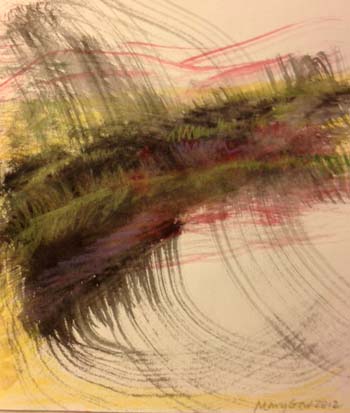
“Water’s Edge,” watercolor and pencil on paper, by Mary GowI went to a talk given by Jessica Murray last week about the unique times we are currently experiencing.
I’m still thinking about it.
I hadn’t heard the term “ecocide” before and it caught my attention as she said it’s a possibility that we are committing it.
Is resorting to physical battles a sign of “spiritual immaturity”?
It wasn’t doomsday predictions but encouragement to remember our power is in our participation as a collective.
Her talk reminded me of the Pachamama Alliance. Their “Four Years Go” video created in 2010 shows in three minutes the underlying message of this post.
The movie may have prompted her to say that to me.
Whatever prompted her, it hit me like a thunderstorm in the desert.
Not many people really knew my mother the way I knew her.
Actually, no one knew her like I did.
And that special knowingness between mother and daughter, and honoring those who paid our way is what Felicia Lowe inspects in her one hour documentary, Chinese Couplets.
The film tells the story of her mother’s identity and what drove her to secrecy about where she was really from.
It’s a heroine’s journey that many immigrant families can identify with. There’s just three days left in her current Indiegogo campaign.
Thank you Ms. Lowe and the lady sitting next to me at the California Historical Society screening of segments from Chinese Couplets.
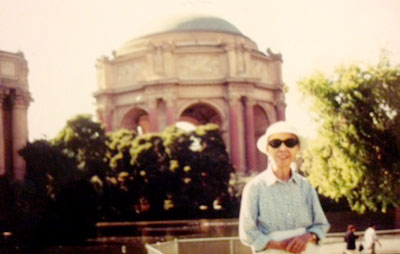
Here’s a photo of my mother when she visited me in San Francisco. She was a courageous woman who withstood tremendous hardships, like surviving near death giving birth and braving wartime invasions.
She paid meticulous attention to details and wrote beautifully.
She loved to recite poetry.
Who knew?
My mother at the Palace of Fine Arts in San Francisco
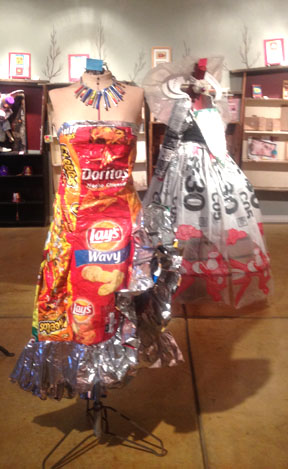
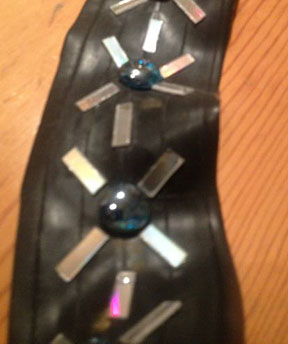
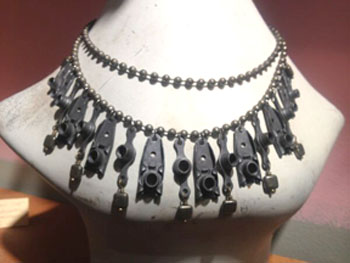
A bike innertube made into a fashionable belt, painted cut-outs from credit cards made into dangling earrings, a necklace from hardware, a dress from Doritos bags. That’s just some of the many examples of inventive thinking at the “Make-Do, a Recycle and Upcycle Art and Fashion Show” at the K Gallery at Rhythmix Cultural Works in Alameda, Calif.
Before I attended the “Make Do” Show at the K Gallery, I wasn’t aware of the term “upcycled art.” Upcycling art embraces the beauty of things we use every day and would normally toss in the trash. I found a site that explains it in greater detail if you want to read more.
“Make Do” features Jennifer Serr, Leonie Holzman, Cheryl Hayward, Bette Barr, Brianna Learnihan, Julie Baron, Linda Lu Castronovo, Susan Leung, Tina Martin, Mary Loughran, Amy Zimmer, Upcycle Clothes, Debbie Callen, Nic Griffin, Chris Rummel, Phil Hargrave, Mary Elizabeth, Stephanie Rodriguez, Michelle Morgan, Joy Johnson, and Shevon Dieterich (and others whose names are not available).
Here’s some creations that caught my eye: Trash Fashion by Nicola GriffinWalking into the gallery I couldn’t miss the mannequins donned with San Francisco-based Nicola Griffin’s trash fashions.
Earrings designed by Cheryl HaywardCheryl Hayward of Olivia Hayward Designs is an Oakland-based artist who, ironically, had taken classes lead by Michele Cassou and Stewart Cubley. You can read more about Cassou in a previous post. Hayward said she wanted to make art that was affordable and applying her artistry to jewelry-making meant more people could buy her art. I could see what she meant since that evening she made some sales.
Innertube belt designed by Leonie HolzmanLeonie Holzman has several pieces in the show including a halter top and a versatile medium-sized pouch. The photo shows a belt she designed using a bike innertube.
Riveted hardware by Tara Evans
This necklace by Tara Evans caught my eye. It’s made from riveted hardware, pyrite, and vintage ball chain.
There must be a Divine reason I am meeting more documentary filmmakers. I admire their ability to align a desire for social change with artistic expression. Most recently I met Nyna Pais Caputi. I could not ignore the power and urgency of her message.
She grew up in India, aware of the issues that surrounded the gender imbalance that involved the illegal killing of female infants and fetuses. When she and her husband wanted to adopt a female Indian girl they found that very few were available. They discovered statistics such as one in every six Indian girls in India don’t live to see their fifteenth birthday.
CBS News reported in an article on the worst places in the world to be a woman, that “India, while a rapidly developing country, still places great cultural burdens on women. In addition to incredibly high rates of human trafficking and prostitution involving women, especially girls, foeticide (the killing of fetuses) and infanticide with females is incredibly high there. As many as 50 million females are reported to have gone missing because of the practice in the last century.”