
Thank You, Seraphine (a Modern Primitive Painter)

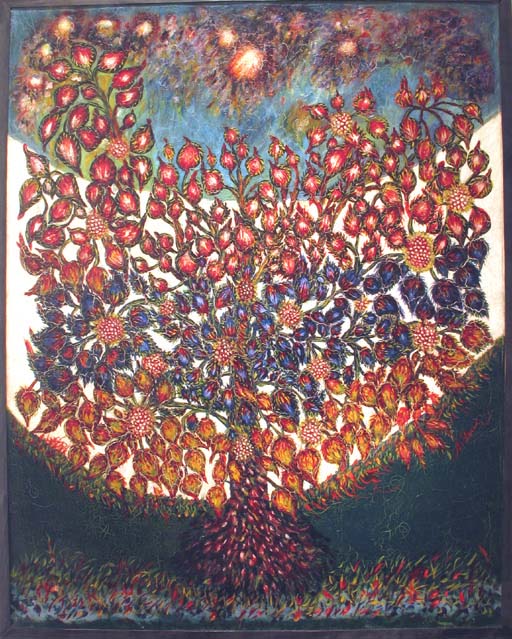
By Seraphine de Senlis
Painting by Seraphine de Senlis

The first movie I streamed from Netflix was “Seraphine.” The critically acclaimed movie’s gentle pace was well-worth the patience it demanded. I loved the quality of light and the passionate sensitivity of this French film.

Seraphine Louis, also known as Seraphine de Senlis, was born in 1864. Her mother died when she was one, and her father died when she was seven. In 1881 she was employed as a domestic worker at a convent, where she received a divine message to create art.

By 1901 she was working as a housecleaner in Senlis. Her talent was recognized in 1912 when a neighbor was showing her work and her employer, German art critic Wilhelm Uhde, realized the artist was his housecleaner. Seraphine painted mostly by candlelight. Click here to read more about her life.

This is one of the few recent films around that I have found about heroic female artists (heroic in the sense of an indomitable spirit). If you’re looking for artistic inspiration watch Seraphine express her irrepresible urge to create.

Tell Your Story Quickly

According to Malcolm Gladwell, author of the bestselling book Blink, humans make decisions often with little or no data. Marketing guru Seth Godin mentions Gladwell’s book in All Marketers Are Liars. Godin says that we can’t function without a story and “consumers make up a theory about what’s going on and then work hard to refine that theory.”

Since we may never get the chance to make a good first impression, what’s the best way to tell your story since the window of impressionability is so short?  Godin says the best way is: 

1. Tell a true story.

2. Make a promise.

3. Be subtle.

4. Engage the customer (it happens fast).

5. Appeal to the senses, not logic.

6. Appeal to your specific audience (not to everyone).

All this points to the best way Godin says to market yourself which is to be authentic.

7 Elements to Include in Digital Storytelling

To continue from yesterday’s thread about digital storytelling, below is a short YouTube video featuring the 7 elements Joe Lambert of the Center for Digital Storytelling recommends you include:

1) Point of View – what is the point of this production? Who am I telling the story to? Why am I telling it now?
2) Dramatic Opinion – employ a question that needs to be answered, such as, will boy meet girl?
3) Emotional Content – research shows that emotion enhances knowledge and understanding.
4) Voice – can touch the viewer deeper than the written word. Inflection can make important differences.
5) Soundtrack – adds another layer of meaning. Be sure it is complementing the piece and not distracting from it.
6) Pacing – time for the viewer to absort and process the information.
7) Economy – a picture may say a thousand words. Or no image may be needed. Also you don’t have to be literal.

4 Simple Tools for Effective Storytelling

At the end of the summer I attended the Craigslist Foundation Bootcamp and one workshop I attended was about storytelling. The teacher was Joe Lambert, Executive Director of the Center For Digital Storytelling. Lambert shared what he called the 4 C’s of Simple Story Tools for storytelling.

The Four C’s are:

1st paragraph: Connect
Use a single moment with expectation

2nd paragraph: Context
What is essential to have audience understand the moment

3rd paragraph: Climax
What change came out of the moment?

4th paragraph: Closure
What are you thinking right now?

Of note, digital storytelling is for pieces 2 to 4 minutes in length.