

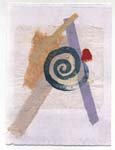
Which of the 5 Universal Shapes Appeals to You the Most?

Target Heart
Monotype by Mary Gow
Last week I asked which shape appeals the most to you. Did you pick circle, square, triangle, cross or spiral? Referring to the book, “Signs of Life, The Five Universal Shapes and How to Use Them” by Angeles Arrien (1992), here’s what the five shapes symbolize:

The Circle – wholeness, the experience of unity
The Square – stability, solidity, security
The Triangle – dreams, visions, goals
The Cross – relationships, integration
The Spiral – growth, evolution

You can take Arrien’s preferential shapes test in her book, available at her site: http://www.angelesarrien.com/products.htm

My favorite shape didn’t make the 5 universal ones. Look for a post in the future about this.

Jason Alba’s Tips on Using LinkedIn

LinkedIn.com is the world’s largest business network. Not too long ago I heard Jason Alba speak about maximizing LinkedIn.com. Alba specializes in personal relationship management and can show you how to – see www.jibberjobber.com.

Here’s highlights from his talk:

  1. It’s more important to have relevant contacts than a large number of contacts.
  2. Join up to 50 relevant groups within LinkedIn and making a comment, asking a question or posting to those groups at least once a week so members begin to recognize you.
  3. Your best opportunity to pull people in is by your summary.
  4. Engage the reader by telling a story. Give P-A-R statements which are Problem – Action – Result.
  5. You can probably fit about 6 or 7 PAR statements in the 2000 characters alloted in the summary section.
  6. Don’t use your current “title” at work but rather use that space for your 5 second elevator pitch – like “I help companies manage . . .”
  7. OK, my new title is painter/writer/designer of educational products and services that contribute to positive social change. What’s your new title?

$1,732.32 per hour

Do you think we’re in a social media revolution? This video produced by www.socialnomics.com will show you some statistics to answer that question. Are we in the middle of a fad or is it the biggest shift since the Industrial Revolution? In the first version Socialnomics first produced of “Social Media Revolution” in July 2009, if you were paid $1 every time an article was posted on Wikipedia you would earn $156.23 per hour. In the updated version you see here, produced in May of 2010, you would earn $1,732.32 per hour.

Part 3 of 3 on How to Get a Million Unique Visitors

Continuing from the last two day’s postings, Bill Belew shared how he got one million unique visitors to his websites. Here are the rest of his tips:

5. Write in a network. Find other people who write about something similar to you. Check blogcatalog.com.
6. Write for your social network. This means for audiences such as LinkedIn, Facebook, Digg, Stumbleupon, Reddit. However, be aware that this kind of traffic won’t especially pay the bills.
7. Write till it catches on. Don’t give up too soon. He mentions the Japanese proverb about three years: From wikiquote.com here’s supportive details:
石の上に三年 ishi no ue ni san nen
a. Literally: Three years on the rock.
b. Meaning: It takes a long time sitting on a stone before it becomes warm. Expect to work at something for three years before you see results.

The +1 tip was:
8. Learn from an expert who has done what you are wishing to do and can tell you how. And you do not have to pay for it.

You can also find out more about blogging through Belew’s book: How Wilby Got 20 Million People to Read His Blog, and How You Can Too. You can buy it at his website.