
Three Strategies to Satisfy Your Hunger

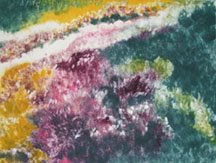
The Garden, a monotype by Mary Gow
I believe how we feed ourselves is how we nurture ourselves. And creativity flows when we feel nurtured.

Do you have a diet you’ve decided to try this new year? I’ve been studying the 17 Day Diet, the Belly Fat Cure and the Paleo Diet. I have been a flexitarian (a semi-vegetarian moving towards becoming a vegetarian).

Seems the latest hottest new diet is the 17 Day Diet. One friend has lost 4 lbs. in four days on 17 Day Diet. It involves 4 rounds of 17 day regimens and calls for 17 minutes of exercise each day.

I have tried Jorge Cruise’s Belly Fat Cure and had some luck with it though I tire of counting 15/6 every day. That stands for no more than 15 grams of sugar and 6 servings of carbs a day.

I think the Paleo Diet might be worth investigating though it would make vegetarians cringe. This diet mimics the way the cave man ate, which means no sugar or carbs or grains and consists of eating lean meats (free-range hopefully), fruits and vegetables.

I’d rather not be on any “diet” since it implies it is not my natural way of eating. If I have to give up sweets and sweet potatoes it’s going to be a challenge. What are you finding works for you?
3 Personal Reflections on the Hero’s Journey

I once set out to go around the world and travel continuously in one direction to make a complete circle of the globe. I accomplished that goal but not without the challenges of a hero’s journey. A few things I see upon reflection:

1. You might get stumped on Step 6 (Tests, Allies, Enemies), don’t give up then. Don’t let the first challenge or new friends derail you from your journey. Especially the first people. It was exciting to be in Bali, a place I had dreamt of visiting. But instead of painting in Bali as I was planning to do, I let the people I met distract me. Don’t succumb to these decoys if you can help it.

2. The Rule of Three applies on your journey. Expect to encounter at least three big challenges (see 6, 8 and 10). I stuck with my journey in spite of the distractions and was savvy enough by the third test to say, no, I’m going to do things differently this time.

1. The Ordinary World
2. The Call to Adventure
3. Refusal of the Call
4. Meeting with the Mentor
5. Crossing the First Threshold
6. Tests, Allies, Enemies
7. Approach to the Inmost Cave
8. Supreme Ordeal
9. Reward (Seizing the Sword)
10. The Road Block
11. Resurrection
12. Return with the Elixir

3. Traveling long distances is NOT required for a hero’s journey. We go on hero’s journeys all the time. We are constantly being tested. In fact I’m on one now. It’s between my ears.

Happy Travels to you this New Year!

Anatomy of a Story: Twelve Steps to Herohood

While researching Joseph Campbell and following your biliss, I found the website of Scott Myers to be a helpful resource for screenwriting. His post on September 14, 2010 talks about the Hero’s Journey in Campbell’s book (first published in 1949), The Hero With a Thousand Faces. George Lucas, Jim Morrison, Bob Weir, and Mickey Hart are among the many artists who have credited Campbell’s book as influential in their work.

Campbell’s research into the structure of myths throughout history show this common structure. An overview of those twelve steps is below. Can you identify with currently being in any of these stages?

Act 1
1. The Ordinary World
2. The Call to Adventure
3. Refusal of the Call
4. Meeting with the Mentor

Act 2
5. Crossing the First Threshold
6. Tests, Allies, Enemies
7. Approach to the Inmost Cave
8. Supreme Ordeal
9. Reward (Seizing the Sword)
10. The Road Block

Act 3
11. Resurrection
12. Return with the Elixir

The following video is a discussion about those twelve steps by Christopher Vogler, author of “The Writer’s Journey, Mythic Structure for Storytellers & Screenwriters.”

The Adventure is the Reward

Eternal Optimist
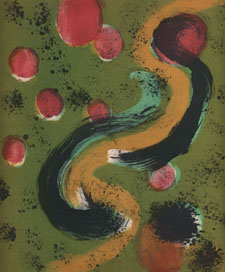
Monotype by Mary Gow

I think the concept of bliss appeals to me so much because it makes so much sense and is so opposite of what I was told in my childhood. Even Donald Trump says “You have to do something you like!”

MOYERS: Would you tell this to your students as an illustration of how, if they follow their bliss, if they take chances with their lives, if they do what they want to, the adventure is its own reward?

CAMPBELL: The adventure is its own reward – but it’s necessarily dangerous, having both negative and positive possibilities, all of them beyond control. We are following our own way, not our daddy’s or our mother’s way. So we are beyond protection in a field of higher powers than we know. One has to have some sense of what the conflict possibilities will be in this field, and here a few good archetypal stories like this may help us to know what to expect. If we have been impudent and altogether ineligible for the role into which we have cast ourselves, it is going to be a demon marriage and a real mess. However, even here there may be heard a rescuing voice, to convert the adventure into a glory beyond anything ever imagined.

MOYERS: It’s easier to stay home, stay in the womb, not take the journey.

CAMPBELL: Yes, but then life can dry up because you’re not off on your own adventure. …

From p. 197 of “The Power of Myth,” by Joseph Campbell with Bill Moyers, 1988.

So following your bliss may not be totally blissful. Pack some powerful doses of courage in your toolkit.