
14 Tips from Wayne Freedman on Storytelling (continued)

Before continuing on with the 14 tips I gathered from Wayne Freedman’s presentation on storytelling, I thought you might enjoy this video of him produced by Warren Mayer. In under 60 seconds hear what Freedman’s advice is to journalism students.

Below is the continuation of the previous post sharing tips I garnered from Freedman’s keynote at the day-long workshop, the “National Academy of Television and Academy Sciences (“NATAS”) Storytelling Workshop.” It was put together by video journalist and photographer Jeremy Carroll and held at the American Broadcasting Company-owned station, KGO-TV, in San Francisco.

5) Let the interviewee find his comfort zone in the interview. This could be by finding a comfortable place to sit. Move the subject around the room, like by the wall, by a window, etc.

6) Find a reason to make people want to talk.

7) Use keywords. When Freedman’s on-camera he said he doesn’t have his script written out, he uses keywords.

8) Throw in visual appeal. Change focal length and mix up your shots with long, medium, close, super close, super long. Shoot in different places. Add more people to the shot.

9) The news story should be able to stand on its own – have a beginning, middle and end. Introduce people by their name (since interest in a person brings interest in the story). Set the scene … “It was the best of times, it was the worst of times.” Add a surprise reveal.

10) Use a Thesaurus! If you get writer’s block use a thesaurus to help you. A thesaurus can also help you identify themes and ways to open or close your story.

11) Bring your own wisdom to your work. Listen to things you say to yourself and put those observations into your story! Come up with simple truths. That add universal appeal to your story. “One small step for man, one giant leap for Mankind,” is an example.

12) Situate yourself for success. “Luck is only good when you’re ready for it and prepared to take care of it when it happens,” said Freedman. He tells the story of when he covered baseball player Cal Ripken, Jr. He didn’t get an interview in advance with Ripken but found a spot next to stand next to Rifken’s wife. When he came to be with his wife, Freedman was able to ask him a few questions. He got the story.

13) People usually have the ability to remember three facts. Three. There’s more to a story than the 5 W’s (where, what, when, why, who).

14) The final tip is a flip from what we’re used to hearing. “You’re only as good as your worst story,” said Freedman. “It’s about time, distance, and people management.”

You can find Freedman’s book at Amazon.

More helpful storytelling tips from other video journalists continued after lunch. Stay tuned and I’ll share those notes in the future.

You might also enjoy:
5 Tips for Producing Digital Multimedia
3 Memorable Quotes from Steve Jobs
3 Reasons to Write Your Own Obituary

14 Tips from Wayne Freedman on Storytelling

The keynote speaker has won 51 Emmy Awards from the Northern California Chapter of the National Academy of Television Arts and Sciences. That was plenty of endorsement for me to see Wayne Freedman as he led the first half of a workshop I attended where six San Francisco television journalists shared their tips on telling news stories.

The official event title of the day-long was the “National Academy of Television and Academy Sciences (“NATAS”) Storytelling Workshop.” It was put together by video journalist and photographer Jeremy Carroll and held at the American Broadcasting Company-owned station, KGO-TV, in San Francisco.

The list of presenters included four video journalists:
-Wayne Freedman of KGO-TV
-Jeremy Carroll, photographer for NBC11
-Da Lin of KRON-TV
-Garvin Thomas of NBC Bay Area Proud

and television reporters:
-Julie Watts of KPIX (CBS)
-Noelle Walker of KTVU

Freedman’s book, It Takes More Than Good Looks To Succeed at Television News Reporting, is now in it’s second edition (2011), and required in many college journalism programs in the U.S., Canada and Europe. He shared some information on storytelling that’s worthy of sharing:

1) Feature writing techniques may work better for many television news stories than the traditional news story structure. Instead of putting the most important relevant facts first and the details later, tell the story with a beginning, middle, and end. And add an element of surprise or a big reveal.

Freedman gave several examples of how storytelling is strengthened by not going in chronological order of the actual event and moving elements around. For example, a story he did about a woman’s freeze-dried dog. The order of reveal is not chronological.

2) Storytelling is about structure and timelines. There’s not one timeline, there’s three:

a) the order of events;
b) the order which you shot those events; and
c) the order you put the timelines in the story.

Move the timelines around to add more interest, which changes the structure.

3) Set the Scene. This might be done with one line or ten lines. Don’t give away the story with the first line or begin with the punch line.

4) The viewer needs to have an emotional investment in the subject. Television is a visceral medium. “The road to the head goes through the gut,” said Freedman. Tell stories through people. Compelling stories are visceral stories. “Visceral” means appealing to our instincts more than our intellect.

If the viewer cares about the person they’ll care about the story. Find a person to tell a story. “Sometimes you can tell two or three stories through one person.”

Read more about this Wayne Freedman’s tips in my next post.

You might also like:
7 Elements to Include in Digital Storytelling
4 Simple Tools for Effective Storytelling
Where Do Opals Come From?

Change Your Life in 7 Days

Light Reading After Thanksgiving

Here we are, headed for Christmas. I am feeling appreciative of life and little things that really are big things, like hot water. I LOVE hot water!

According to Water.org, half of all the hospital beds in the world are occupied by patients suffering from ailments related to unsanitary water. How blessed are we to have clean air, clean water, and a working toilet? There’s probably a link between freedom to create and every day utilities functioning.

Now I’m reading my third book by hypnotist and best selling author, Paul McKenna, Ph.D. He’s sold three million books in the last three years! I hadn’t heard of him until a few months ago when a friend showed me two of his books and told me he’s the Dr. Phil of the United Kingdom. So I’ve read I Can Make You Sleep and I Can Make You Thin. Both of those books come with a CD.

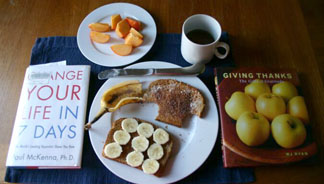
Now, I’m reading Change Your Life in 7 Days. Get a free download of an MP3 that goes with this book and put yourself in a trance of confidence! You will have to give your name and email address.

Here’s my summary of the seven days:

Day 1: Who are you? You are who you pretend to be, who you are afraid to be and who you truly are. “The better you feel on the inside, the better your life will become.” – p. 37

Day 2: Emotional Intelligence: master how you picture things in your mind and learn to replay the biggest successes in your life. Vividly imagine the confident you.

Day 3: Reframe: our perspective is often the product of the questions we ask ourselves. You get what you focus on.

Day 4: Identify your goals: find out what you really want to accomplish in your lifetime and map out some goals to achieve them.

Day 5: Health: fine tune your spiritual, physical and mental well-being.

Day 6: Prosperity: create your financial abundance plan.

Day 7: Happiness: McKenna discusses the 8 triggers to happiness from studies by Professor Mihaly Csikszentmihalyi’s research:
1. Clear Goals – have a stated purpose, a clear goal.
2. Immediate feedback – we need continual feedback to know we’re on track).
3. Ability to Concentrate on the Task at Hand – focus on one thing at a time.
4. The Possibility of Successful Completion – preparation and baby steps toward a goal help.
5. Total Involvement – doing something for the sheer joy of doing it.
6. Loss of Self-Consciousness – ability to return to that flow feeling before we were around 5 years old and started judging ourselves.
7. A Sense of Control – feeling like we have a say in the direction of our lives.
8. Time Distortion – time seems to pass a lot quicker or slower than usual.
Learn to replay times when you’ve felt like you were in a state of flow. Blow up those pictures in your mind so they are huge, bright, with punched up colors.

A summary of day 7 is that a happy person does at least one difficult thing every day.

After seven days rinse and repeat and repeat and repeat and repeat. Be mindful of the software you run your brain with.

OK, Mr. McKenna, will there be an I Can Make You Creative?

What Defines a “Real Artist”?

True artistry is not about paint brushes and canvas says author and business blogger Seth Godin in his best-selling book, Linchpin. “You can be an artist who works with oil paints or marble, sure. But there are artists who work with numbers, business models, and customer conversations. Art is about intent and communication, not substances.”

Godin continues “An artist is someone who uses bravery, insight, creativity, and boldness to challenge the status quo. And an artist takes it personally.”

In Linchpin, Godin explains one of his key concepts about a true artist’s consciousness: “Art is a personal gift that changes the recipient.”

A cook is not an artist. A chef who creates a new type of dish is an artist.

In what ways are you an artist?