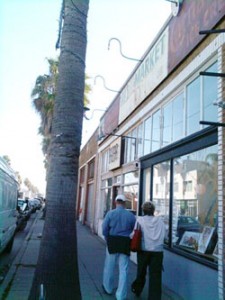
Palm tree-lined Abbot Kinney BoulevardTo get the full affect of arriving in bohemian Venice, take the magical three mile walk or bike ride along the beach from the Santa Monica pier. You can rent bikes there. Choose the ones with the most comfy looking seats. The terrain is flat so the ride will only take about twenty minutes.
When you get to Venice and mosey inward a few blocks to a street called Abbot Kinney. There’s elegant modern nondescript storefronts next door to crusty houses built 80 years ago, the kind with porches and a swing in the front. And there’s restaurants with customers sitting ear to ear and there’s no sign of the name of the place.
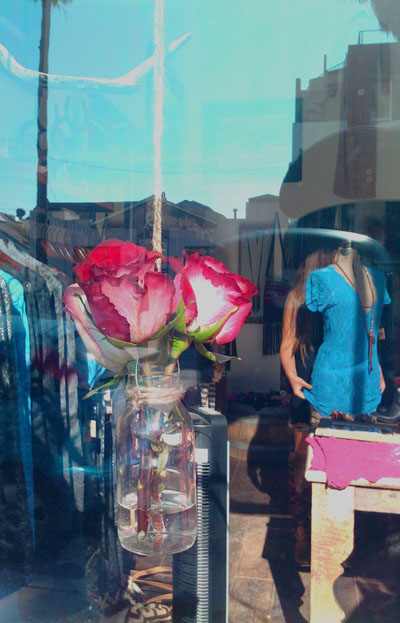
Not a box store you’ve heard of on the street. The Jin Patisserie has an entryway that had an irresistible sensitivity to light.. The website is worth a visit if you can’t physically go there.
"Entry to Jin Patisserie," photo by Mary Gow
I liked the presentation of these two roses.
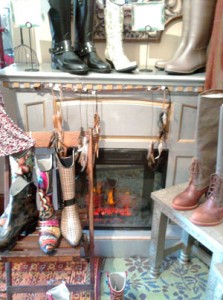
Inside one of the fashionably retro bungalows you’ll find a charming portable fireplace, the kind you can move from one room to another. The shop owner said it was from Home Depot. I was mesmerized.
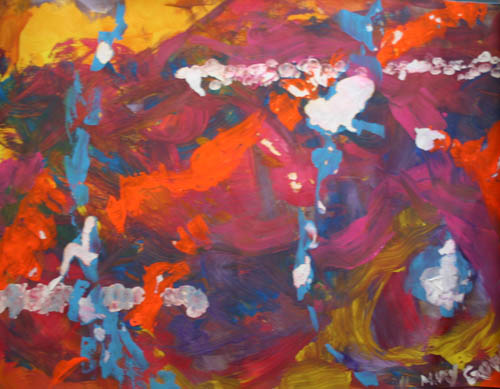
"Untitled No. 1," by Mary GowEver let yourself paint without a purpose, reason, or plan? It’s called process painting, source painting, soul painting, or intuitive painting (“IP”). It felt like an un-learning process to me. Permission to do whatever comes to mind.
I wanted to explore intuitive painting after hearing about it and took my first class at Creative Juices Studio, founded by Chris Zydel, who has over 30 years of experience as a creativity guide. In “Intuitive Painting as Spiritual Practice,” an article Zydel wrote, she explains the essence of IP:
In the realm of art for outcome there is a constant mental evaluation going on. Your mind is continually asking itself things like “Is this good, is this bad, do I like it, do I not like it, is it beautiful, is it ugly?” When you are painting as a spiritual practice you are trying to let go of judgment and comparison and inviting mercy and curiosity to be your companions as you create. When you approach your creativity with the attitude of holding everything that comes out of you with compassion instead of criticism you have an opportunity to experience what I like to call Radical Self Acceptance.
I loved my first “official” intuitive painting experience. I realize sometimes I already make art this way, letting myself start not knowing where it is going to go and instead letting things emerge in the process. I did feel freer using paper and tempera instead of acrylics and canvas.
There’s guidelines within the IP environment that I felt supported by. Three of them in particular appealed to me.
The first one is no commenting on anyone else’s work. This creates a safe environment of non-judgment.
The second guideline was signing every piece when you’re finished. There’s something consoling about signing work and declaring it “finished.” Zydel says “Signing it means you own it.”
The third guideline I found especially appealing. Treat everything you create with respect. I like the ‘No Should-ing on Yourself’ that is part of intuitive painting.
Zydel says intuitive painting is all about saying YES to who you are:
When you are painting for the process you are operating from the belief that you are inherently a creative being and that actually everyone is creative. You are learning to say a great big YES to your creative self and to cultivate trust and faith in your creativity separate from things like talent or skill. In the world of art for product the assumption is that only a very few special, rare and gifted people have the right to call themselves artists , and that you should only be encouraged to exercise your creativity if you are extremely talented.
After Zydel gave me the orientation as a first-time participant, I started my first painting. There was a large assortment of tempera paints to choose from. There was no quota on how many paintings I could produce. It’s not about what kind, how many, which one. It’s about being present in the process. A beautiful sacred process.
Recently the San Francisco Bay Area Press Photographers Association held their annual all day Digital Multimedia Workshop at San Jose State University. The first half of the day there were a series of talks in an auditorium-like setting and the second half of the day there were four segments of an array of workshops to choose from. That was when I wanted to clone myself. Some highlights I gathered from the day are:
1. The new Final Cut Pro X (video editing software) is much less expensive than earlier versions but older versions won’t work with this version (in other words, it’s not backwards compatible). Apple offers a free 30 day download. Final Cut Express is the less expensive version of older versions of Final Cut Pro but is near the same price as the new Final Cut Pro X.
2. Think TABLET. Peter Young, adjunct professor of multimedia at San Jose State, moderated a panel discussion ks and magazines with Jackson Solway (oncemagazine.com) and social media consultant, Miki Johnson (mikijohnson.com). The consensus is tablets are where we are going. Noteworthy points include:
-Self-education is becoming more important and the tablet is an excellent vehicle for it since it is easy to hold and creates intimacy with the viewer.
-Studies have shown that people have the basic tolerance to watch approximately 20 pictures in a slideshow.
-The viewer wants maximum 400-650 words of text associated with any slide.
-People have loyalty to a serial slide show, delivered at the same time, same channel, like every two weeks.
3. You can produce an interactive magazine using Adobe InDesign. This workshop was taught by Pulitzer-Prize winner and San Jose State multimedia instructor Kim Komenich. Now Adobe is offering a slick iPad compatible magazine or interactive publication through Adobe.com for the Adobe Digital Edition Publishing Suite, Single Edition, for $395 for one year. We watched a short video (see above) of students at the University of Oregon making a digital magazine.
4. Produce your digital sound using Audacity, a free cross-platform sound editor. Think about how you cut and paste in a Word document and you can apply that same principle to cutting and pasting bits of sound with this tool.
5. Windscreens are essential to getting decent clear sound. A good resource for windscreens is Rycote.
I couldn’t be at two places at once and missed “Hands-On Video Lighting,” “Multimedia for Newspapers,” and though I was delighted with photogapher Robert Beck’s morning presentation I didn’t see “More with Robert Beck – Sports Illustrated Special Projects.”
All in all I learned some valuable things I can apply. I haven’t bought my Lavalier microphone yet but it’s going to be my next sound purchase.
If you’re a WordPress fan don’t miss my notes from the San Francisco 2011 WordCamp!
Check out my notes from the Social Change Film Festival that will remind you of simple abundance. Happy New Year!
Hardy proposed we go on a media diet because we all have inside of us an eight year old who is highly influenced by what we see and hear. And you wouldn’t let your eight year old watch someone being shot or attacked, would you?
Everyday we feed out brains food for visualizations. Gaze at what you want and your mind has an imprint of it. Gaze at what you don’t want and your mind has an imprint of it. Be mindful of what you take in, Hardy reminds us. Be like a parent watching over your eight year old, because your brain is a powerful manifesting machine.