Paper Cutout Artist: Kurt Stoeckel

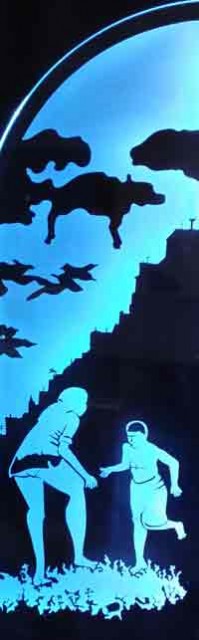
Dancing Under a Rorshach Cloud, sandblasted glass panel by Kurt Stoeckel
February 10th is the last day of the Henri Matisse works on paper exhibition at the Museum of Modern Art in mid-town Manhattan. This link takes you scrolling through parts of the show.

We have a talented paper cutout artist right here in northern California. Kurt Stoeckel lives in the Bernal Heights area of San Francisco.

His paintings, photographs, sculpture and glasswork all look like paper cutouts. Now he’s creating LED lamps. One-of-a-kind ones.

An elongated glass panel stands 65 inches tall by 22 inches wide near a doorway in his studio. Etched into it is a line drawing that looks like a cutout of two people dancing under a cloud that has animal-like shapes inside of them.

The sandblasted panel has a background light that comes with the ability to change from red to green to blue or combinations those three colors using a remote control.

Dancing Under a Rorshach Cloud reflects the current fascination of paper cutout artist, Kurt Stoeckel.

“I’ve always liked indirect lights that are kind to the eye,” he said.

The elegance of his work reflects what he values. “I love the functionality and design of the Art Deco Era. Every product was designed to have some intrinsic value beyond its use.”

It was an era of “a conscious and universal attempt to make utilitarian items also pleasant to live around. For example toasters didn’t have to have all those deco designs and shapes. And because they did they were pleasant to live around and they also made toast. Making toast was secondary and the rest of the time it’s a beautiful piece of art. It’s a generosity to all of us to live around the comfort of a pleasing design.”
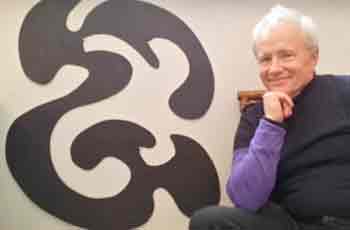
Kurt Stoeckel, paper cutout artist. Photo by Mary Gow
Stoeckel grew up in Scranton, Pennsylvania. His father loved photography and theater. “He trusted me with his cameras even after I dropped one. I appeared in every play requiring a child in a perambulator,” he said. His grandfather liked everything mechanical. “He taught me how to cut out metal shapes with a torch when I was ten.”

“That was my beginning, memorizing lines and welding things together.”

In 1994 he moved to Bernal Heights. “Painting had replaced metal sculpture.” He credits Bernal artist Toby Klayman as an influence. She taught painting at City College. He took her class and later became her teaching assistant.

He took lots of pictures. “I thought of myself more as a “What if” experimenter than a photographer creating compositions. Photography was one meditative roll of 36 exposures of film a week.”

“I still find joy and peace in a meditative walk with a camera. I now choose compositions that begin with ‘What If?’ I imagine turning a decade of photos into a ten day stop-action film.”

He considers himself now primarily a paper cutter. “I’ve made 10,000 of them while living here. I still paint. My paintings look a lot like paper cut outs.”

Since 2008 Stoeckel also teaches photography and theater technology classes in a local high school.

“I feel very fortunate to have a waiting list of collectors for my paintings,” he said.

He continues experimenting.
It’s All About Your Bass

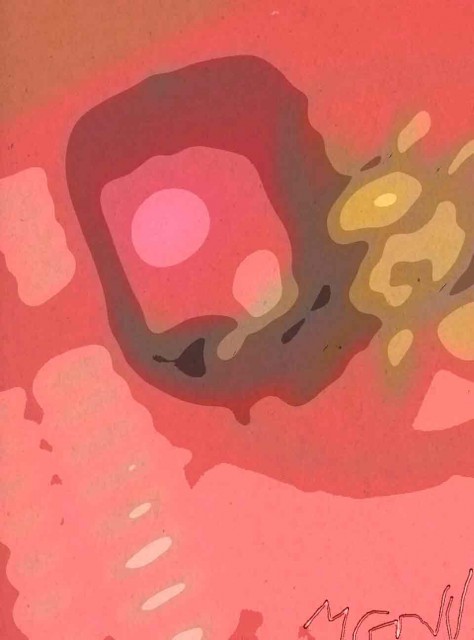
The Red Mouse by Mary Gow

“You are creators, and you are vibrational beings. You are more about electronics; you are more about electricity; you are more about vibration than you are about the physical stuff that you think you are about. This physical stuff that you think you are about is all vibrational.”
Abraham (Excerpted from the workshop: Spokane, Wash. on July 07, 1999)

With the 57th Annual Grammy Awards last night, I’m reminded of the song that was number one on the music charts for eight weeks in the summer of 2014, “All About That Bass,” written by Kevin Kadish and Meghan Trainor.

In an interview with Billboard Magazine target=”_blank”, Trainor says the song is all about loving yourself and your gluteus maximus.

From an auditory sense, your “bass” is your vibration. And often what we attract is what we’re putting out in our vibes. What we get is what we see.

I remember long ago when my sisters left for college. We three had shared one small bedroom. I repainted the walls in the tiny half bath we had shared. Then I put up a bunch of photos of various places in the world. I wasn’t really thinking of it as my vision board. There was a picturesque scene of green rolling hills that look just like what I see in northern California. Another photo was of a skier coming down a mountain in Austria.

Staring at them everyday must’ve made an imprint in my subconscious because I got myself to those rolling hills and to skiing in Austria – an accomplishment for a girl from humble beginnings.

What kind of neural pathways are you making with your thoughts? What kind of vibes are you putting out in the world?

About the Art:
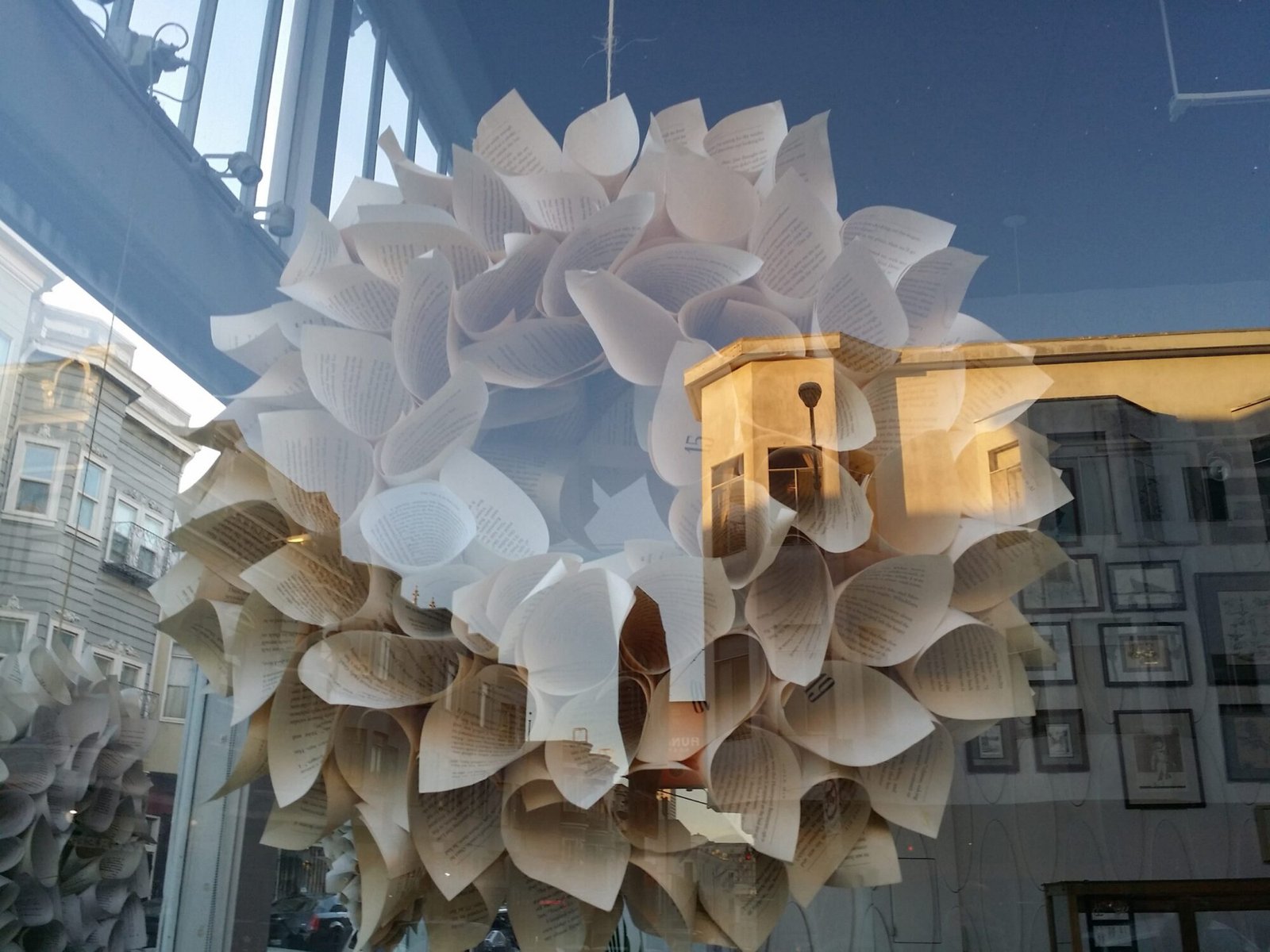
I took a photo of my red mouse on my red mouse pad. I then applied the Paper Artist app to the photo.

One of My Coaches

What are your action items?

What progress have you made to get those done?

What’s the big picture goal?

Those are just a few of the questions life coaches ask.

One of my current coaches is Darren Hardy, who’s a motivational speaker, author, and publisher of Success Magazine.

I’m getting daily coaching and mentoring by subscribing to Darren Daily. By signing up you’ll be reminded to strive for excellence, stay fit, don’t look for external validation.

His daily messages are delivered Mondays through Fridays via email, text or both.

The dailies are concise.

In a recent post I mentioned graphic facilitation. Some of his videos use this technique.

Hardy also has some excellent tips for goal setting in his book, The Compound Effect.

He shares these forms online for free. Here’s the link. The downloadable forms are available in several languages.

You can sign up for your own dose of Darren Daily at http://www.DarrenDaily.com/

Creating a Smooshing Business Plan

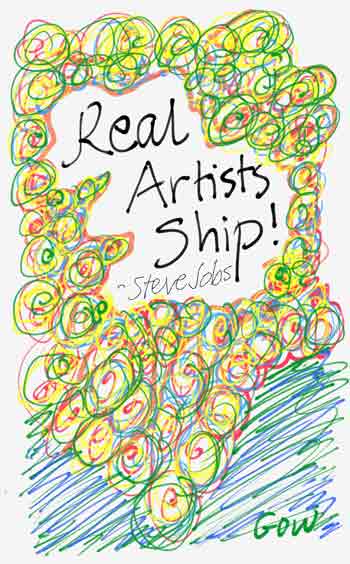
"Real Artists Ship" Quote by Steve Jobs, Drawing by Mary Gow
“Real Artists Ship” Quote by Steve Jobs, Drawing by Mary Gow
Did you ever think drawing stick figures could help your career?

It wouldn’t hurt if you’re trying to draw out instead of write out what you want.

It was a profession I’ve been researching called “graphic facilitation,” also known as “sketch notes,” and “graphic recording.”

What I find fascinating about graphic facilitation is it’s like visual transcribing. And there’s some places you can learn this skill. Two that come to mind are The Grove Consultants International in San Francisco, and Alphachimp Studio online.

There’s a terrific book called The Back of the Napkin: Solving Problems and Selling Ideas with Pictures, by Dan Roam. You learn how to scribe meetings with a blend of drawings with words which can engage your audience more than PowerPoint would.

I could go on about graphic facilitation but it was in researching that obsession that I found a highly useful book called “Business Model You,” by Tim Clark.

In a previous post I mentioned Emilie Wapnick (puttylike.com) who coaches people on how to smoosh their many talents into a career path.

I like her idea and there’s one page business plan in Business Model You that can help you map out a way to utilize your talents.

Check out Business Model You’s business plan form. There’s three different versions of the one page plan you can download here.

Happy Smooshing.