
14 Tips from Wayne Freedman on Storytelling

The keynote speaker has won 51 Emmy Awards from the Northern California Chapter of the National Academy of Television Arts and Sciences. That was plenty of endorsement for me to see Wayne Freedman as he led the first half of a workshop I attended where six San Francisco television journalists shared their tips on telling news stories.

The official event title of the day-long was the “National Academy of Television and Academy Sciences (“NATAS”) Storytelling Workshop.” It was put together by video journalist and photographer Jeremy Carroll and held at the American Broadcasting Company-owned station, KGO-TV, in San Francisco.

The list of presenters included four video journalists:
-Wayne Freedman of KGO-TV
-Jeremy Carroll, photographer for NBC11
-Da Lin of KRON-TV
-Garvin Thomas of NBC Bay Area Proud

and television reporters:
-Julie Watts of KPIX (CBS)
-Noelle Walker of KTVU

Freedman’s book, It Takes More Than Good Looks To Succeed at Television News Reporting, is now in it’s second edition (2011), and required in many college journalism programs in the U.S., Canada and Europe. He shared some information on storytelling that’s worthy of sharing:

1) Feature writing techniques may work better for many television news stories than the traditional news story structure. Instead of putting the most important relevant facts first and the details later, tell the story with a beginning, middle, and end. And add an element of surprise or a big reveal.

Freedman gave several examples of how storytelling is strengthened by not going in chronological order of the actual event and moving elements around. For example, a story he did about a woman’s freeze-dried dog. The order of reveal is not chronological.

2) Storytelling is about structure and timelines. There’s not one timeline, there’s three:

a) the order of events;
b) the order which you shot those events; and
c) the order you put the timelines in the story.

Move the timelines around to add more interest, which changes the structure.

3) Set the Scene. This might be done with one line or ten lines. Don’t give away the story with the first line or begin with the punch line.

4) The viewer needs to have an emotional investment in the subject. Television is a visceral medium. “The road to the head goes through the gut,” said Freedman. Tell stories through people. Compelling stories are visceral stories. “Visceral” means appealing to our instincts more than our intellect.

If the viewer cares about the person they’ll care about the story. Find a person to tell a story. “Sometimes you can tell two or three stories through one person.”

Read more about this Wayne Freedman’s tips in my next post.

You might also like:
7 Elements to Include in Digital Storytelling
4 Simple Tools for Effective Storytelling
Where Do Opals Come From?

5 Tips for Producing Digital Multimedia


Recently the San Francisco Bay Area Press Photographers Association held their annual all day Digital Multimedia Workshop at San Jose State University. The first half of the day there were a series of talks in an auditorium-like setting and the second half of the day there were four segments of an array of workshops to choose from. That was when I wanted to clone myself. Some highlights I gathered from the day are:

1. The new Final Cut Pro X (video editing software) is much less expensive than earlier versions but older versions won’t work with this version (in other words, it’s not backwards compatible). Apple offers a free 30 day download. Final Cut Express is the less expensive version of older versions of Final Cut Pro but is near the same price as the new Final Cut Pro X.

2. Think TABLET. Peter Young, adjunct professor of multimedia at San Jose State, moderated a panel discussion ks and magazines with Jackson Solway (oncemagazine.com) and social media consultant, Miki Johnson (mikijohnson.com). The consensus is tablets are where we are going. Noteworthy points include:
-Self-education is becoming more important and the tablet is an excellent vehicle for it since it is easy to hold and creates intimacy with the viewer.
-Studies have shown that people have the basic tolerance to watch approximately 20 pictures in a slideshow.
-The viewer wants maximum 400-650 words of text associated with any slide.
-People have loyalty to a serial slide show, delivered at the same time, same channel, like every two weeks.

3. You can produce an interactive magazine using Adobe InDesign. This workshop was taught by Pulitzer-Prize winner and San Jose State multimedia instructor Kim Komenich. Now Adobe is offering a slick iPad compatible magazine or interactive publication through Adobe.com for the Adobe Digital Edition Publishing Suite, Single Edition, for $395 for one year. We watched a short video (see above) of students at the University of Oregon making a digital magazine.

4. Produce your digital sound using Audacity, a free cross-platform sound editor. Think about how you cut and paste in a Word document and you can apply that same principle to cutting and pasting bits of sound with this tool.

5. Windscreens are essential to getting decent clear sound. A good resource for windscreens is Rycote.

I couldn’t be at two places at once and missed “Hands-On Video Lighting,” “Multimedia for Newspapers,” and though I was delighted with photogapher Robert Beck’s morning presentation I didn’t see “More with Robert BeckSports Illustrated Special Projects.”

All in all I learned some valuable things I can apply. I haven’t bought my Lavalier microphone yet but it’s going to be my next sound purchase.

If you’re a WordPress fan don’t miss my notes from the San Francisco 2011 WordCamp!

Check out my notes from the Social Change Film Festival that will remind you of simple abundance. Happy New Year!

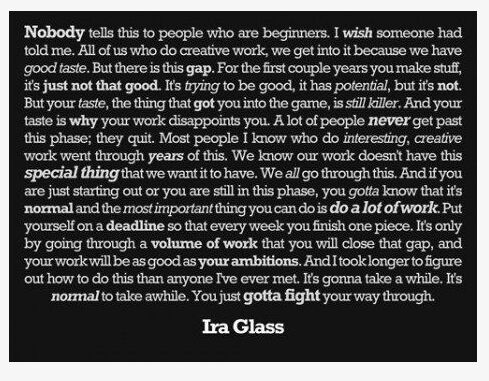
What it Takes to Create

How do you get millions to listen to your radio show? Ira Glass talks about how it takes letting yourself do less than perfect work and trusting you will get to your good work, which becomes your great work.

Enjoy this video created by David Shiyang Liu illustrating the words of Glass.

Two More Nuggets of Inspiration from Ira Glass

I thought you might find this Ira Glass quote inspiring. Create some bad, digressive stuff and keep going.

From Ira Glass
Words I Wish I Had Heard Earlier - from Ira Glass

Continuing from my last post, here’s Ira Glass, Part 2 of 4 on Storytelling. Looking for stories could take more time that producing the story.